
All-on-4 vs. Full Mouth Implants vs. Implant Dentures: Which Full Arch Solution Is Right for You?
All-on-4 vs. Full Mouth Implants vs. Implant Dentures: Which Full Arch Solution Is Right for You?
If you are missing most or all of your teeth, researching your options can quickly become confusing. You may see terms like All-on-4, full mouth implants, implant dentures, snap-in dentures, fixed dentures, and full arch implants used in similar ways.
These treatments can overlap, but they are not always the same.
Some options are fixed in place. Others are removable. Some use four implants. Others may use more or fewer depending on your anatomy, bite, bone structure, and long-term goals.
At PGH Dental Wellness in Pittsburgh, Dr. Samir Gupta and the team help patients compare their options through a whole-health lens. That means treatment planning considers more than missing teeth. Your bite, jaw joints, airway, facial support, comfort, and long-term function all matter.
This guide explains the differences between All-on-4, full mouth implants, and implant dentures so you can better understand which direction may be right for your smile.
For patients who are ready to explore treatment, PGH Dental Wellness offers full arch dental implants in Pittsburgh with a free CBCT consultation.
What Is the Difference Between All-on-4, Full Mouth Implants, and Implant Dentures?
All-on-4, full mouth implants, and implant dentures are all designed to replace many or all missing teeth. The difference is in how the replacement teeth are supported, whether they are fixed or removable, and how the treatment is planned.
In general:
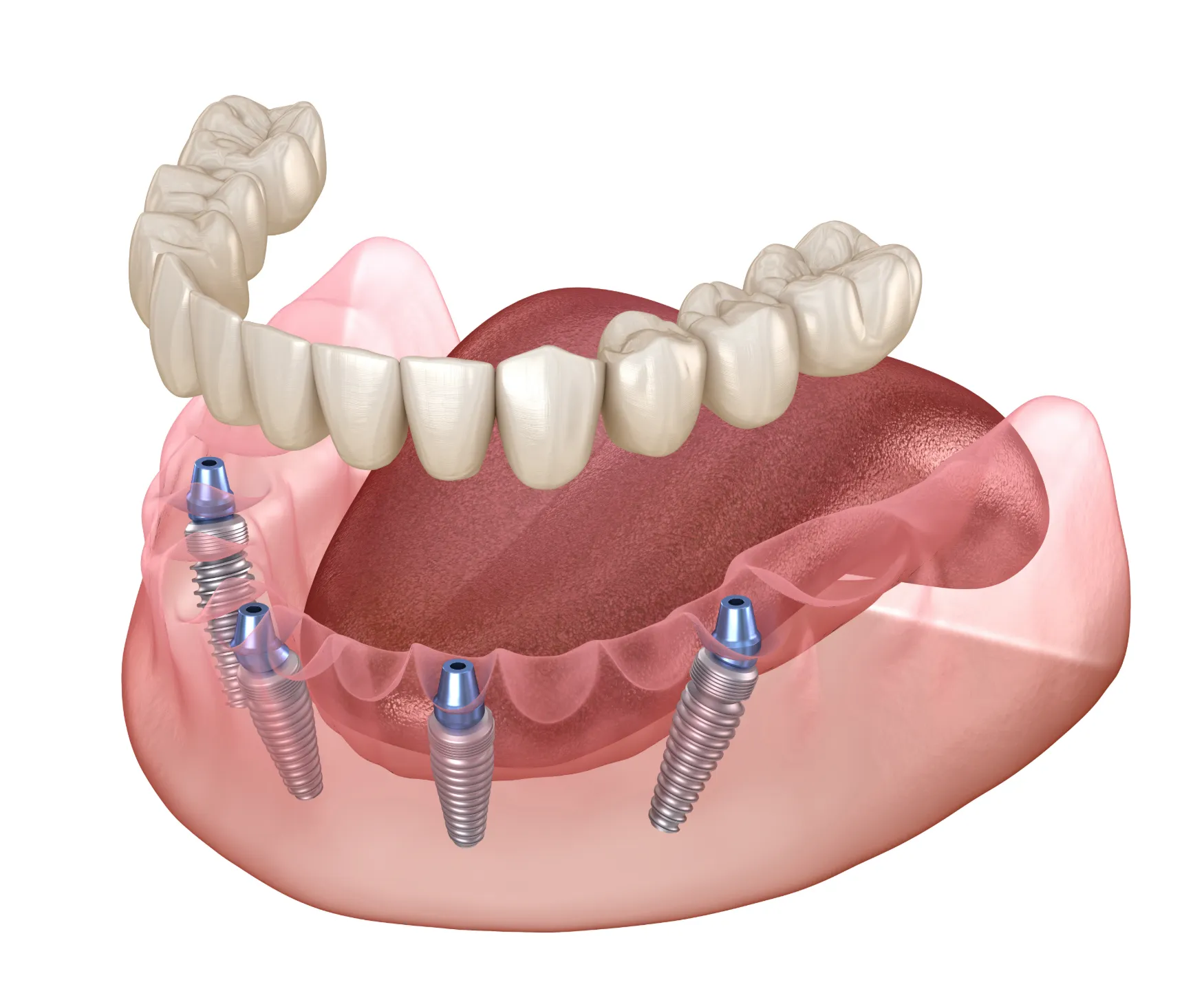
- All-on-4 usually refers to a full arch of replacement teeth supported by four dental implants.
- Full mouth implants is a broad term that may refer to replacing all or nearly all teeth with dental implants.
- Implant dentures usually refer to dentures that attach to dental implants for added stability.
The most important thing to understand is that these are not one-size-fits-all solutions. The right treatment depends on your mouth, your health, your goals, and the type of stability you want.
What Are All-on-4 Dental Implants?
All-on-4 is a full arch implant concept where a complete row of replacement teeth is supported by four dental implants. The implants are positioned to support a full arch prosthesis, often as an alternative to a traditional removable denture.
All-on-4 is commonly discussed by patients who want fixed teeth and do not want to rely on denture adhesive or removable appliances.
All-on-4 may be considered for patients who:
- Are missing all or most teeth in one arch
- Have failing teeth that may need to be removed
- Currently wear dentures and want more stability
- Want an implant-supported full arch solution
- Prefer teeth that feel more secure while eating and speaking
What patients should know about All-on-4
“All-on-4” does not mean every patient only needs four implants. Some patients may benefit from a different number of implants depending on jawbone support, bite force, anatomy, or long-term treatment goals.
That is why a proper evaluation is important. At PGH Dental Wellness, the team does not build treatment around a generic label. Instead, they evaluate the patient first and then recommend the approach that best supports health, function, and comfort.
What Are Full Mouth Implants?
Full mouth implants is a broader phrase. It usually refers to replacing all or nearly all teeth in the mouth with dental implants or implant-supported restorations.
This may involve:
- A full upper arch
- A full lower arch
- Both upper and lower arches
- Implant bridges
- Individual implants and crowns
- A combination of implant and restorative treatments
For example, one patient may need fixed implant-supported teeth for both arches. Another may need single dental implants, implant bridges, crowns, or a more comprehensive restorative plan.
Patients with severe wear, bite collapse, failing dental work, or multiple missing teeth may also need full mouth reconstruction.
What Are Implant Dentures?
Implant dentures are dentures that use dental implants for support. Unlike traditional dentures, which rest on the gums, implant dentures connect to implants in the jaw to improve stability.
Implant dentures can be removable or fixed.
Removable implant dentures
Removable implant dentures are sometimes called snap-in dentures. They attach to implants but can still be taken out by the patient for cleaning.
They are often more stable than traditional dentures, but they may still have more movement than fixed implant-supported teeth.
Fixed implant dentures
Fixed implant dentures are attached to dental implants and are not removed by the patient at home. They are designed to feel more stable and function more like natural teeth.
The right maintenance routine depends on the type of prosthesis used and the patient’s individual needs.
Implant dentures may be considered for patients who:
- Want more stability than traditional dentures
- Are frustrated by slipping dentures
- Want improved chewing ability
- Need a more secure tooth replacement option
- Prefer a removable appliance for cleaning
- Are comparing cost and maintenance options
Side-by-Side Comparison
Here is a simple way to compare the three terms.
This table is a starting point, not a diagnosis. The best option depends on your anatomy, oral health, bite, bone structure, medical history, and goals.
Which Option Feels Most Like Natural Teeth?
Fixed implant-supported teeth typically feel the most stable because they are anchored to implants and are not removed by the patient. Many patients prefer this option because it can provide greater confidence while eating, speaking, and smiling.
However, fixed does not automatically mean best for every person.
Some patients may benefit from a removable implant denture because it may be easier to clean, more appropriate for their anatomy, or better aligned with their budget and maintenance preferences.
The goal is not simply to choose the option that sounds most advanced. The goal is to choose the option that supports your health, comfort, and long-term function.
Which Option Is Best If You Already Wear Dentures?
If you already wear dentures and are unhappy with the fit, implant-supported options may be worth exploring.
You may want to compare All-on-4, fixed full arch options, and implant dentures if your current dentures:
- Move when you eat or speak
- Cause sore spots
- Require adhesive
- Limit the foods you can chew
- Feel bulky
- Affect your confidence
- No longer fit the way they used to
A CBCT scan can help determine whether your jawbone can support implants and which type of implant solution may be appropriate. PGH Dental Wellness uses cone beam CT scanning to evaluate important structures before making treatment recommendations.
Which Option Is Best If Your Teeth Are Failing?
If you still have teeth but many are broken, loose, infected, painful, or severely worn, your treatment plan may involve removing non-restorable teeth and replacing them with an implant-supported solution.
In this situation, your provider needs to evaluate:
- Which teeth can be saved
- Whether gum disease is present
- Whether extractions are needed
- How much jawbone is available
- How your bite fits together
- Whether you have TMJ symptoms
- Whether airway or sleep-related concerns are present
- Whether one or both arches need treatment
Some patients may need periodontal care, restorative dentistry, or a phased treatment plan before moving forward with implant treatment.
Why Bite, TMJ, and Airway Should Be Part of the Conversation
Full arch tooth replacement should not be planned around appearance alone. Your teeth affect how your jaws come together, how your muscles function, how your jaw joints move, and how your face is supported.
If a full arch restoration is not planned carefully, it may create unnecessary stress on the bite, jaw joints, muscles, or prosthesis.
That is why PGH Dental Wellness takes a whole-health approach to implant planning. When appropriate, the team considers:
- Bite balance
- Jaw joint comfort
- TMJ symptoms
- Facial support
- Airway health
- Sleep-related concerns
- Chewing function
- Long-term maintenance
Patients with jaw pain, clenching, headaches, or bite problems may benefit from learning more about TMJ therapy. Patients with breathing or sleep-related concerns may also want to explore the practice’s approach to airway-centric dentistry.
How Cost Can Differ Between These Options
Cost varies because each patient’s needs are different. There is no single price that applies to every full arch case.
The cost of treatment may depend on:
- Whether one arch or both arches are treated
- The number of implants needed
- Whether teeth need to be removed
- The type of prosthesis selected
- Whether the restoration is fixed or removable
- Sedation needs
- Bone support
- Bite complexity
- Supporting periodontal or restorative treatment
In general, removable implant dentures may involve a lower investment than fixed full arch options. Fixed full arch implant treatment may require a greater investment because of the materials, planning, surgical complexity, and prosthetic design involved.
The right question is not only “What does it cost?” It is also “What level of stability, function, comfort, and maintenance is right for me?”
Is Sedation Available?
Yes. PGH Dental Wellness offers sedation options for appropriate patients, including oral sedation and IV sedation.
Sedation may be helpful for patients who:
- Feel anxious about dental treatment
- Need longer or more complex care
- Have avoided dentistry because of fear
- Want a calmer appointment experience
The team will review your health history, comfort level, and treatment plan before recommending a sedation option. You can learn more about sedation dentistry, IV sedation, and oral sedation.
How to Decide Which Full Arch Option Is Right for You
The best choice depends on what you want your new smile to do for you.
If stability is your top priority
A fixed full arch solution may be worth exploring because it is designed to stay secure while you eat, speak, and smile.
If easy cleaning is your top priority
A removable implant denture may be worth discussing because it can be taken out for cleaning.
If you have complex dental problems
You may need a broader restorative plan that includes implants, extractions, bite correction, periodontal care, or full mouth reconstruction.
If you have jaw pain or bite concerns
A TMJ-aware approach is important. Your final teeth should be designed to support your bite and jaw function, not just fill in missing spaces.
If you have airway or sleep-related concerns
An airway-conscious dental team can help evaluate how your oral structures, bite, and jaw position may relate to your overall wellness.
Why PGH Dental Wellness Takes a Whole-Health Approach
PGH Dental Wellness provides advanced, technology-driven dentistry focused on lasting health, function, and confidence. The practice emphasizes prevention, minimally invasive care, patient education, and personalized treatment planning.
For patients comparing full arch tooth replacement options, this approach matters.
Dr. Samir Gupta brings experience in implant dentistry, cosmetic dentistry, restorative dentistry, TMJ disorders, airway-focused dentistry, preventive care, and obstructive sleep apnea treatment. This allows the team to evaluate more than the missing teeth alone.
PGH Dental Wellness also uses advanced technology, including 3D imaging and CBCT scanning, to support diagnosis and planning. Patients can learn more about the practice’s broader implant dentistry, restorative dentistry, and technology services.
Ready to Compare Your Options?
If you are comparing All-on-4, full mouth implants, and implant dentures, the next step is a personalized evaluation.
PGH Dental Wellness offers a free CBCT consultation for patients considering full arch dental implant treatment. This visit helps the team evaluate your jawbone, oral health, bite, airway considerations, and goals so you can better understand your options.
Learn more about full arch dental implants at PGH Dental Wellness or contact the office to schedule your consultation.
Want To Schedule An Appointment?
At PGH Dental Wellness, comprehensive care and lasting trust go hand in hand.